
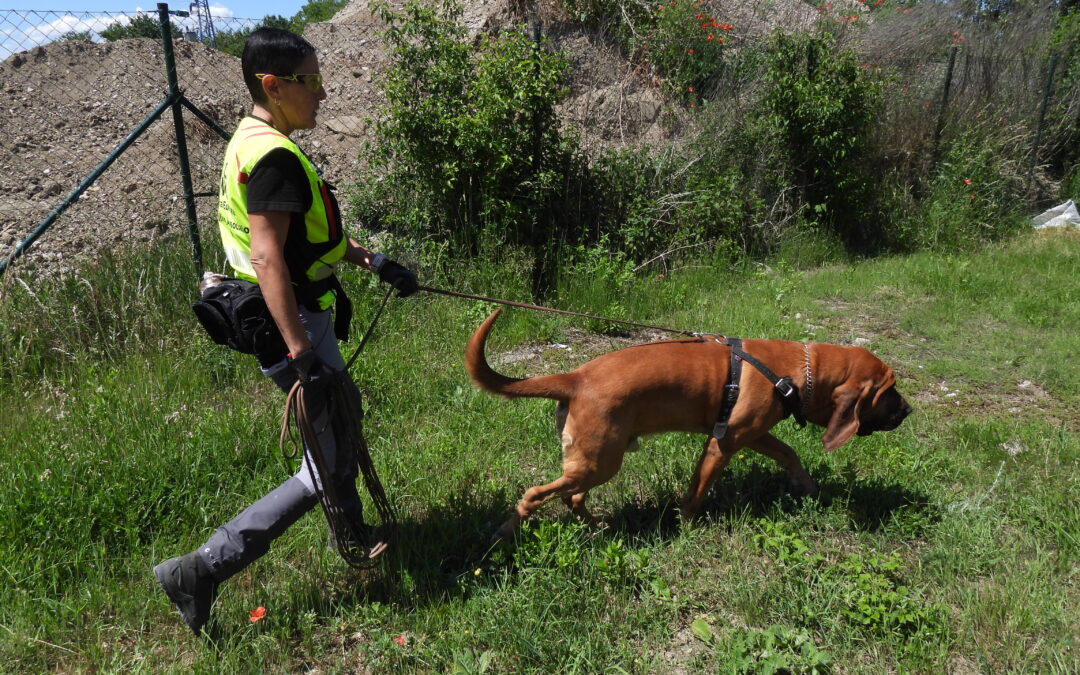
High summer temperatures do not automatically mean that training should be cancelled. They demand better planning, a deeper understanding of canine physiology, and the ability to adapt training to environmental conditions. So what does current scientific research tell us about working dogs in hot weather, and how can those findings be applied to everyday mantrailing practice?
Every summer, the same discussion resurfaces within the working dog community. Is it still safe to train mantrailing when temperatures reach 31–35 °C (88–95 °F)? Should training sessions be cancelled altogether, or is this simply an overly cautious approach?
If we want to make informed decisions, we cannot rely on feelings, assumptions, or long-standing myths. We need to rely on canine physiology, veterinary science, and research conducted on working dogs. And the evidence gives us a fairly clear answer: the problem is not the number on the thermometer itself. The real issue is the combination of factors acting on the dog during work.
A mantrailing dog is not simply walking. It is performing an activity that places significant demands on both the body and the brain. Throughout the track, the dog continuously processes an enormous amount of scent information, makes decisions, changes direction, analyses scent patterns, and often works across challenging terrain. Muscular activity naturally generates heat, and it is entirely normal for a dog’s core body temperature to increase by 1–2 °C during strenuous work. An elevated body temperature alone does not automatically indicate a medical problem. What truly matters is how long that temperature remains elevated and whether the body can dissipate heat efficiently through normal thermoregulation.
This is where summer conditions begin to play a major role.
Unlike humans, dogs do not cool themselves by sweating across the surface of their skin. Their primary cooling mechanism is panting. As ambient temperature rises, the difference between the dog’s core body temperature and the surrounding environment becomes smaller, making heat dissipation progressively more difficult. Add physical exertion to the equation, and the dog’s body begins operating much closer to its physiological limits—often long before the handler recognizes what is happening.
A common argument is, „It’s only 32 degrees outside—that’s not really that hot.“
The problem is that the reported air temperature is measured approximately two metres above ground level and always in the shade. A mantrailing dog, however, works in a completely different environment. Its nose spends most of the track only a few centimetres above the surface. Above asphalt, concrete, or dry soil, a layer of substantially hotter air develops. The dog is not inhaling the „temperature of the asphalt,“ as is sometimes incorrectly claimed, but it is inhaling the air immediately above that heated surface—air that may be several, and sometimes more than ten, degrees warmer than the air measured at human height. This significantly increases the physiological demands placed on the dog’s thermoregulation.
Heat does not affect physiology alone—it also affects olfaction.
As the dog begins panting more intensely to cool itself, a conflict emerges between two essential biological functions. Scent detection and thermoregulation rely on different airflow patterns through the nasal passages. The more intensely a dog pants, the less efficiently it can process airborne scent molecules. The result may be slower decision-making, reduced scent discrimination, decreased accuracy, or increased uncertainty when solving complex scent problems.
Recent experimental research has even demonstrated that higher levels of physical exertion can reduce olfactory sensitivity before the dog reaches clinically significant heat stress. In other words, scent processing efficiency may begin to decline well before obvious signs of overheating become apparent.
This does not mean that training should be prohibited whenever temperatures exceed 30 °C (86 °F). Quite the opposite.
Recent research involving working detection dogs operating in hot environments has reached a very interesting conclusion. Dogs are capable of maintaining a high standard of performance even in elevated temperatures—provided that the handler actively manages the associated risks. Particular attention should be paid to planning appropriate working intervals, ensuring adequate recovery, and continuously monitoring the dog’s physical condition throughout the session.
For those of us involved in mantrailing, this leads to an important practical conclusion.
Heat should not automatically mean cancelling training.
It should mean changing the objective of the training session.
If the temperature is 33 °C (91 °F), it is probably not the right time to plan kilometre-long trails filled with multiple turns, complex scent problems, and repeated working sessions. That does not mean the dog cannot learn.
Quite the opposite.
Summer provides an excellent opportunity to focus on short, methodically structured exercises that develop the handler’s ability to read the dog, encourage independent decision-making, improve work at the start of the trail, strengthen scent direction identification, and refine the dog’s ability to solve individual scent problems without unnecessary physical strain.
It is equally important to recognise that a dog’s performance is influenced by far more than temperature alone.
Humidity, ground surface, direct solar radiation, wind, physical fitness, acclimatisation, hydration status, age, and breed-specific characteristics all play significant roles. Two dogs working side by side under identical environmental conditions may respond in completely different ways.
For that reason, there is no universal temperature threshold at which we can simply say, „Today it’s safe to work, tomorrow it isn’t.“
There is another aspect we also have to acknowledge.
Operational deployment.
If a missing child or an elderly person disappears when the temperature is 34 °C (93 °F), nobody waits until October.
Working dogs will be deployed.
The difference between training and an operational search lies in the objective.
Training can be postponed, modified, or shortened.
A real deployment rarely offers that luxury.
That is precisely why it is important to prepare dogs to work safely in higher temperatures—not recklessly or at any cost, but through systematic acclimatisation, progressively increasing exposure, shorter working intervals, adequate recovery periods, and continuous monitoring of both the dog’s physical and mental condition.
This is exactly how professional search-and-rescue organisations and operational working dog units prepare their dogs around the world today.
A good handler does not make decisions based solely on the thermometer.
A good handler makes decisions based on the dog.
They observe the dog’s breathing, willingness to work, ability to concentrate, quality of decision-making, and the speed of recovery once the work is complete.
They understand that the best training session is not the one that leaves the dog completely exhausted, but the one in which the dog learns something new while remaining physically and mentally ready to work again tomorrow.
Heat, therefore, is not a reason to stop training.
It is a reason to train more intelligently.
And that is precisely where recreational training differs from the professional preparation of an operational working team.
In my view, a working dog does not need perfect conditions.
It needs a handler who understands what is happening inside the dog’s body before the first signs of fatigue even begin to appear.
That is where true responsibility lies.
Not in protecting the dog from every challenge, but in recognising the point at which training continues to build capability—and the point at which it simply becomes unnecessary risk.
Because the goal is not to finish today’s trail.
The goal is to build and preserve a healthy, reliable four-legged partner capable of performing when it truly matters.
Author: Mirka Zacharová